Remember the last time it was raining and you tried to call a lyft or uber? The groan you expressed when you saw the price double and time to pickup grow exponentially longer?
That’s surge pricing. No fun for you, and no fun for lyft or uber. But, very quite lucrative for drivers if they’re incentivized effectively!
Surge pricing occurs when marketplace startups have a supply deficiency. Demand for their service they provide has spiked, and they need to drive more freelancers to work and fulfill this demand – immediately. Otherwise, customers are left waiting, and eventually will abandon the service.
As mentioned in a previous post, there are two main strategies we employed to drive supply to meet demand during a spike:
- Linear Surges – Increasing per-job compensation: Essentially, a ‘flash deal’ advertising a higher wages if freelancers choose to work during high-demand hours. Eg. “Earn 20% more on Fridays and Saturdays 9pm-3am.”
- Graduated Surges – Increasing per-job prices sequentially: Think ‘loyalty program.’ The more you fly Delta, the more points you earn and the better the rewards get. Eg. “Complete 1-5 jobs and earn 10% more, complete 5+ jobs and earn 20% more per job.”
When we launched linear surges, we generally saw the following increase in active freelancer supply and fulfillment:
measured within 6 hours of surge start & end. note: ‘jobs’ took 2-4hrs to complete, on avg.
| Surge Bonus | Active Freelancer Supply Increase | Demand fulfillment Increase |
| 30% | 10% | 5% |
| 40% | 15% | 10% |
| 50% | 20% | 15% |
| 60% | 22% | 17% |
| 70% | 25% | 20% |
More than often when we needed to surge, it was because demand was 2x or more than normal during that period, compared to previous weeks. This meant that we needed to drive 2x or more supply to maintain consistent production turnaround time.
For us, that meant producing a robust, fact-checked research report in 12-24hrs. For companies with immediate abandonment issues like Uber and Lyft, that means matching a driver with a rider in 10 minutes or less.
As you can see, Linear Surges resulted in 2 main limitations:
- It’s too expensive to try to drive 50% more freelancers to work.
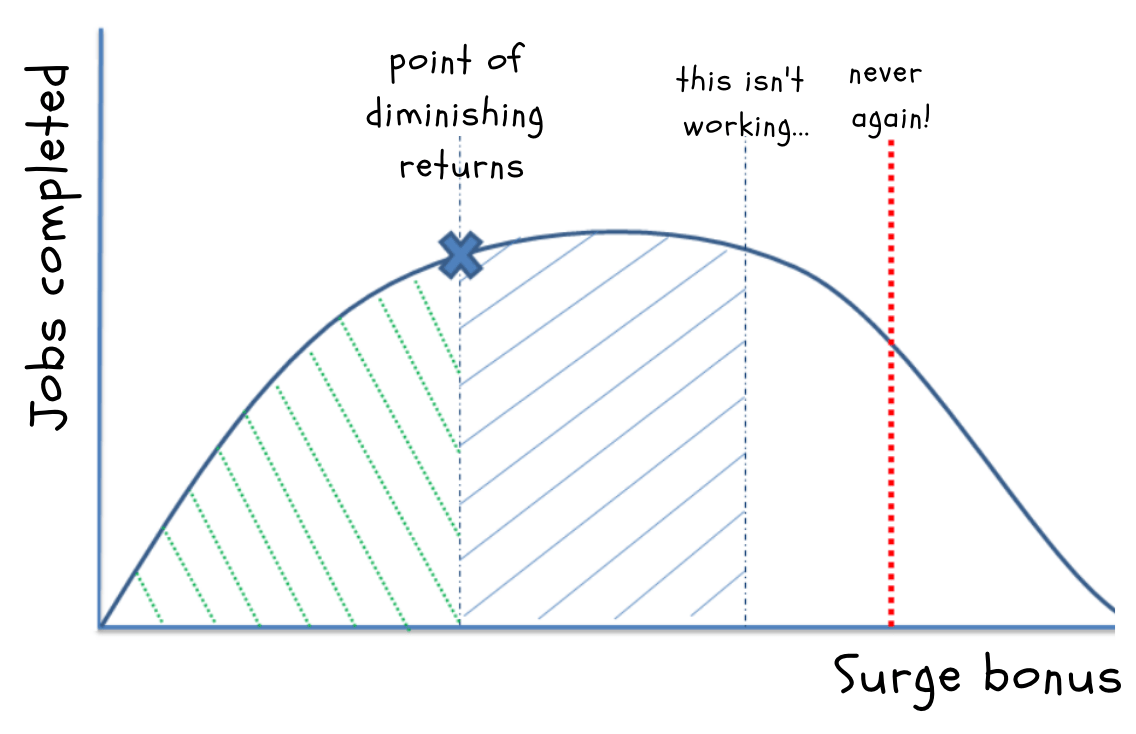
- At a certain point, a higher surge bonus did not result in more active freelancers or more productive freelancers. (law of diminishing returns)
And so, we experimented with Graduated Surges…
Our hypothesis was that our researchers would react to graduated surges the way consumers react to frequent flyer loyalty points – opting to complete more work on our platform in order to collect greater bonuses.
Results were as expected! When we launched the following Graduated Surge Bonus, we consistently saw a 20% increase in active freelancer supply and ~60+% increase in fulfillment. The same 20% of analysts were incentivized to complete 3x more jobs during the time that we needed them most!
| Surge Bonus (per job) | Jobs completed to earn graduated surge bonuses |
| 30% | 2 |
| 40% | 3 |
| 50% | 4+ |
The success of graduated surges came from the fact that freelancers were incentivized to earn more for completing more work. During graduated surge periods, they’d complete as many jobs as possible to maximize their earnings.
This meant that we only needed 20% more freelancers to fulfill ~60+% more work during a spike.
Graduated surges were also less expensive because most analysts wouldn’t complete more than 2 jobs during the 12-hr surge period. The boost in job fulfillment came from a very small population of highly productive senior researchers who completed 5+ jobs during graduated surges. Overall, everyone was happy with graduated surges!
- Margins were 30% greater.
- Freelancer Productivity was 3x greater.
- We were able to increase the % of research completed within 24 hrs from 80% to 95% consistently.
Instead of taking the high-effort, high-cost, high-risk route of trying to increase our active supply of researchers, we took the more thoughtful route and simply increased the productivity of supply of our researchers by giving them better incentives work more. In the end, we didn’t need more researchers, we just needed more active ones!
 Cathy Huang